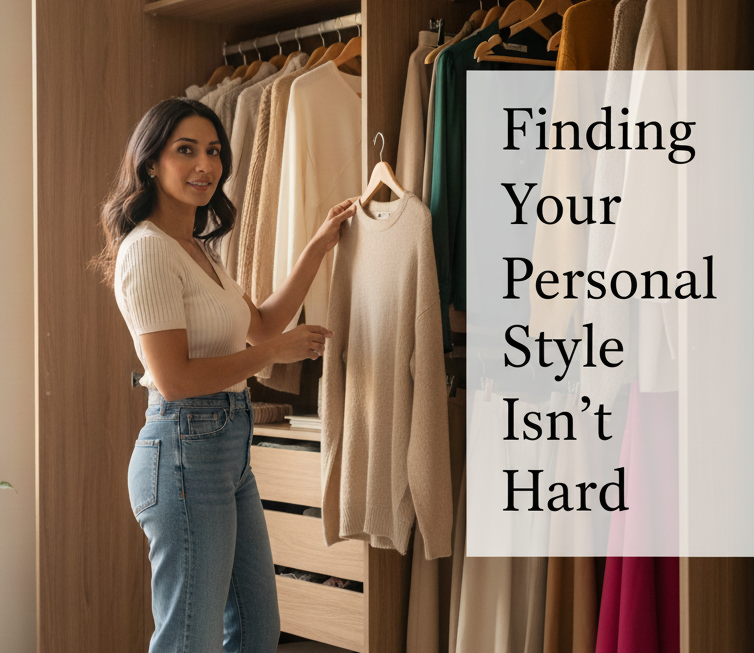
For years, my mornings started the same way.
I’d stand in front of my closet, surrounded by clothes I liked, scrolling Pinterest boards I had carefully curated, remembering YouTube videos I had watched about “finding your personal style”… and still think:
“I have nothing to wear.”
Not because I didn’t own clothes — but because my brain went completely blank.
If that sounds familiar, let me tell you something that took me way too long to realize:
finding your style isn’t about trends, aesthetics, or buying more clothes.
It’s about understanding how you actually live.
Once I figured that out, everything changed.
The Question That Changed Everything

The biggest mistake I was making was asking the wrong question.
I kept asking:
What’s my style?
But the question that finally unlocked everything was this:
What am I actually getting dressed for?
Not the wedding you attend once a year.
Not the vacation outfits you save on Pinterest.
But your real, everyday life.
When I sat down and thought honestly about it, my days mostly revolved around:
- Working from home
- Running errands or going to casual classes
- Occasional work events or intimate gatherings
That’s it.
Yet my wishlist was full of clothes meant for a life I wasn’t living.
No wonder I felt disconnected from my wardrobe.
Step 1: Dress for Your Real Life, Not Your Fantasy Life
Once I identified the three main things I get dressed for, I asked myself:
- Do I need comfort or structure?
- Do I want to look approachable or authoritative?
- Do I want to feel bold, creative, calm, or put-together?
For me, the answer was simple:
I wanted to feel comfortable, creative, and confident — even on days I stayed home.
That clarity alone removed so much confusion.
Step 2: Stop Chasing “More” — Choose What You Truly Love
Here’s where I had to be brutally honest with myself.
Instead of endless options, I limited myself to 3–5 items per category:
- Bottoms
- Tops
- Shoes
- Accessories
- Bags
At first, it felt restrictive.
But then it felt free.
I stopped asking, What’s trendy?
And started asking, Would I wear this every week?
If two items served the same purpose, I picked one.
If something needed ironing, constant adjusting, or felt uncomfortable — it was out.
This wasn’t about building a “perfect” capsule wardrobe.
It was about building a realistic one.
Step 3: Think in Categories, Not Exact Items
Another game-changer:
I stopped shopping for specific pieces and started choosing categories.
Instead of:
- Blue loafers
I thought:
- Colorful flats
Instead of:
- That exact bag I saw online
I asked:
- Do I need a crossbody or a tote for my lifestyle?
This made my wardrobe flexible — not fragile.
Step 4: Accessories Are a Style Shortcut
I used to underestimate accessories.
Now I see them as identity anchors.
I stopped forcing myself into things that didn’t suit my life (like delicate earrings I’d forget to remove) and leaned into what felt natural:
- Hoops I could wear all day
- A scarf style I loved
- Glasses that actually felt like me
- One or two “signature” pieces that felt personal
Style isn’t about owning everything — it’s about repeating what feels right.
The Rule That Saved Me From Impulse Buying
This part was hard — but powerful.
Whenever I wanted something new, I had to:
- Write it down
- Wait one full month
- Ask myself:
- Would I still buy this if it cost twice as much?
- Can I make at least five outfits with what I already own?
Most things didn’t survive the wait.
And the ones that did?
Those became my most-worn pieces.
Waiting taught me to trust myself again.
Outfit Formulas > Random Outfits
Instead of reinventing the wheel every morning, I started creating outfit formulas.
For example:
- Button-down + straight pants + flats
- Knit top + flowy skirt + sneakers
- Oversized sweater + tailored pants + bold accessory
Not exact outfits — structures.
So when my brain goes blank, I don’t panic.
I just follow a formula I already know I love.
Your Closet Isn’t the Problem — Perspective Is
Something unexpected happened during this process.
I realized I already owned clothes I liked —
I just wasn’t seeing them clearly.
When I imagined how my favorite fashion creators would style a piece I ignored, suddenly it clicked:
I don’t hate this item — I just didn’t know how to wear it.
Sometimes, all we need is a fresh perspective.
You Don’t Need an “Aesthetic”
This might be controversial, but I truly believe this:
No one has one aesthetic.
We like many things.
We change.
We evolve.
Buying ballet flats during “balletcore” doesn’t mean you dress like a ballerina every day — it just means you liked the shoes.
And that’s okay.
Style isn’t about being unique or trendy.
It’s about being honest.
If you like something — even if everyone else has it — you’re allowed to like it.
Final Thought: Style Is a Relationship With Yourself
Finding your style isn’t a destination.
It’s a practice.
It’s paying attention.
It’s documenting what you love.
It’s allowing yourself to change.
It’s choosing outfits you like — even for the grocery store.
And most importantly:
It’s letting go of the idea that you need to fit into a box.
You already have a style.
This formula just helps you finally see it.
Discover more from Wear Like Wow
Subscribe to get the latest posts sent to your email.